
How many teeth can I have composite bonding on?
You can get composite bonding on any one of your ‘smile zone’ teeth – typically one to ten teeth, although there is no real upper limit. However, most patients who choose to have composite bonding at our practices in East Grinstead and Rochester have it applied on one or more of their upper front teeth. When composite bonding is applied to teeth outside of this zone, it is usually for tooth-coloured or white fillings rather than cosmetic reasons.
While some patients choose to get a full makeover on most or all of their teeth in the smile zone, and others only fix a chip on one or two teeth, how many teeth you have bonded is up to you. During your consultation at Enhance Smiles, we’ll talk about what you’d like to improve in your smile and how we can make your teeth look natural and symmetrical with composite bonding.
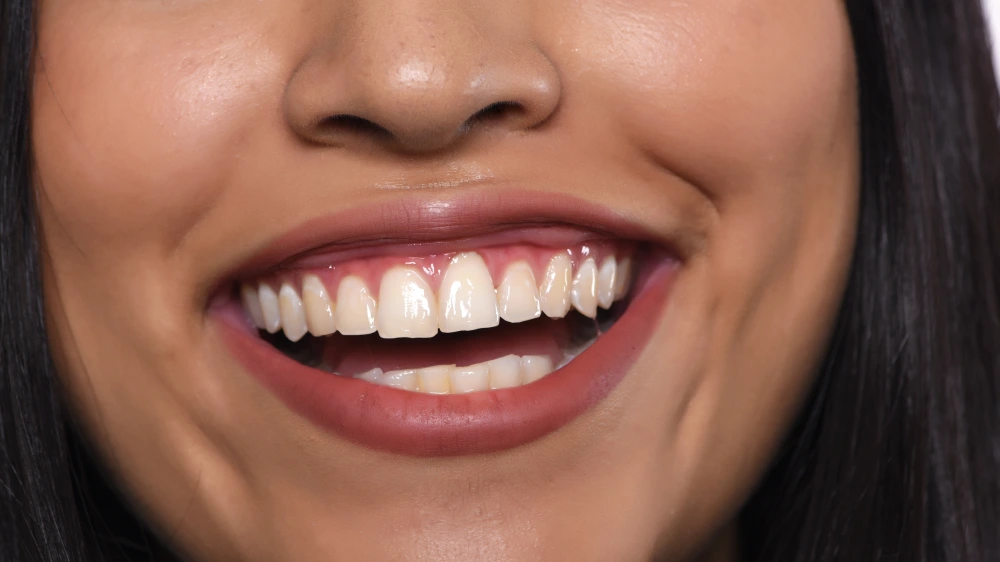
What is the ‘smile zone’ for composite bonding?
The smile zone is made up of the teeth most visible when you smile; typically your upper 4-8 front teeth, plus the matching lower front teeth. This is the area most patients focus on when they’re considering composite bonding, as it has the biggest impact on how your smile looks day to day. Wider smiles may show a few more teeth at the sides, which your dentist will take into account during your consultation.
We use composite bonding inside this zone to treat minor imperfections, such as small chips, cracks and gaps between your teeth. This involves sculpting the composite resin directly onto your tooth, then hardening it with a special light. The process is minimally invasive, and can usually be done in one appointment.
The smile zone is more suitable for composite bonding than other parts of your mouth for a number of reasons:
- Lower bite force
Your front teeth generally don’t have as much pressure placed on them when you bite or chew as other teeth, such as molars. As composite bonding is slightly softer than natural tooth enamel, this makes it a safe choice to repair chips and cracks at the front of your mouth.
- Aesthetic appearance
The teeth in the front of your mouth are easier for your dentist to reach, so it will be much easier for them to shape the composite resin to completely mimic your smile’s natural appearance. Additionally, the teeth in the smile zone are usually the first people notice when you smile, so composite bonding is a great choice for this area if aesthetics are your priority.
- Minimally invasive and reversible
Unlike many other dental treatments, composite bonding is both reversible and involves removing little or no natural tooth enamel. This means that if you choose composite bonding, the natural surface is left undamaged and your front teeth can remain healthy and strong.
Can I have composite bonding on my back teeth?
Yes, we can place composite bonding on your back teeth, but we do not usually apply this for cosmetic reasons. Instead, we use the composite resin for fillings, worn surfaces or minor fractures. Composite bonding on your back teeth is also known as a ‘white filling’ as this is usually the same material as composite resin on your smile zone.
Composite or white fillings allow us to preserve more of your natural tooth when you do have a filling than other methods (such as amalgam or crowns).
If you’re considering a composite filling, keep in mind that composite bonding on your back teeth can wear down faster than natural tooth enamel, especially if you grind your teeth. For especially large cavities, we may recommend a crown. If the damage is extensive or there is no way to save the tooth, we may also recommend dental implants.
Which teeth do you not recommend for composite bonding?
We cannot place composite bonding on your front teeth in the following situations:
- Active tooth decay or cavities (for front teeth)
- Patients with active, untreated gum disease or bleeding gums
- Severely decayed or structurally damaged teeth
- Missing teeth (dentures, bridges or implants are required for these)
- Crowded or severely misaligned teeth
- Severe teeth grinding
While we do not generally place composite bonding on molars or back teeth for cosmetic reasons, we can still use it for fillings and cavities, as well as other cases where there is some structural damage to your teeth.
How do you decide how many teeth I need bonded?
There is no strict upper limit to how many teeth you can have fitted with composite bonding. However, at Enhance Smiles in Rochester and East Grinstead, our dental team will generally decide how much, and whether you need composite bonding on the following factors:
- Symmetry
Applying composite bonding to only one or two teeth can sometimes make other teeth look worn or irregular in comparison. We may suggest grouping several teeth to create a more even height and appearance.
- Smile width
If you have a broader smile, you may show more teeth at the sides, so you may want to have more teeth bonded so that the cut off point is less obvious.
- Condition of your teeth
We typically only apply bonding for cosmetic purposes rather than severe damage to your teeth. During your initial consultation, your dentist will take a look at your overall oral health before discussing your treatment options.
Is it possible to have composite bonding on only one tooth?
Yes, you can have composite bonding on just one of your teeth, for example to repair a small chip, an area of discolouration that does not respond to whitening, or a jagged edge. Composite bonding can also be used to repair small chips and cracks in your teeth. However, you may wish to consider having composite bonding on more than one tooth if there will be a noticeable difference in appearance after the bonding.
Can I have composite bonding on my teeth?
Absolutely! However, composite bonding is most suitable for the teeth in your ‘smile zone’, but when needed, we do provide white or composite fillings for back teeth, which take on more of the biting and chewing forces when you eat. While some of our patients only choose to have one or two teeth bonded, many choose an entire ‘smile makeover’ of all the teeth in their smile zone. Composite bonding is an entirely reversible treatment which is minimally invasive and does not damage your healthy tooth enamel, so if your teeth and gums are otherwise in good condition, it’s usually possible to have the procedure.
Our dental team are experienced in composite bonding and other areas of cosmetic dentistry, and will help you find a treatment for your chipped, cracked or discoloured teeth that works for you.
Explore composite bonding at East Grinstead or Rochester
Frequently asked questions
As composite bonding is a non-invasive procedure, you should not feel any pain during the procedure. We usually carry out composite bonding without a local anaesthetic, but if you have tooth sensitivity or dental anxiety, please do let us know so we can offer an appropriate treatment option.
No – you cannot place composite bonding directly onto a crown or implant, as the composite cannot attach to porcelain or metal the same way that it does onto natural tooth enamel. If you have implants and damage your crown, contact us to have it replaced.
If you grind your teeth, we offer custom-made night guards designed to prevent damage to both your tooth enamel and composite bonding. We’ll let you know how often to wear it, how to take care of it and clean it.